


The Ultimate Guide to Poster Frames & Large Art Display (2026)
You’ve finally unrolled that vintage movie poster you’ve been saving, a piece of art you truly love. But the excitement quickly turns to frustration. The thought of it rippling behind cheap plastic or trying to find a frame for its non-standard size is overwhelming, isn't it? You’re not alone. We’ve heard from hundreds of customers tired of frames arriving broken or discovering that off-the-shelf options just don't do their art justice. It’s a common story: you invest in a print you love, but the final display falls flat.
This guide is your solution, built on decades of professional framing experience. We promise to give you the expert knowledge to choose, measure, and select the perfect poster frames that protect your art and create a stunning, professional display at a fair price. We’ll walk you through everything from archival-quality materials that prevent fading to simple sizing techniques that guarantee a flawless, gallery-quality fit for any print, every single time.
Key Takeaways
- Learn to distinguish between flimsy plastic frames and professional, gallery-quality options to ensure your large art looks its best.
- Understand the key differences between wood and metal moldings to select a material that complements your art's style and ensures long-term durability.
- Discover the most common standard sizes for poster frames and learn why certain prints, like official movie posters, often require a custom fit.
- Find out how to choose the right glazing-glass or acrylic-and why UV protection is essential for preventing your prints from fading over time.
What are Poster Frames? Defining Quality in Large Format Displays
At its core, a poster frame is a lightweight yet sturdy structure engineered specifically to protect and display large-scale prints. The term once brought to mind flimsy plastic and cheap acrylic, the kind of temporary solution found in a college dorm room. That era is over. Today, professional poster frames are crafted from high-quality wood and metal, transforming casual prints into sophisticated decor. While the basic concept has deep roots in the history of picture frames, modern large-format framing is a specialized craft focused on balancing aesthetics with physics.
For any print larger than 18x24 inches, structural integrity becomes the number one priority. At this size, the combined weight of the glazing, backing, and the print itself exerts significant stress on the frame's corners and rails. A weak frame will bow, separate at the joints, or warp over time, compromising the artwork it’s meant to protect. A professional frame doesn't just display your art; it preserves its value and enhances its visual impact. The simple act of adding a high-quality border elevates the perceived value of a print, signaling that what's inside is important and worth protecting.
Poster Frames vs. Standard Picture Frames
While they serve a similar purpose, frames designed for large posters and those for small 5x7 photos are built to solve different problems. The key distinctions lie in their materials and construction, which directly impact durability and safety.
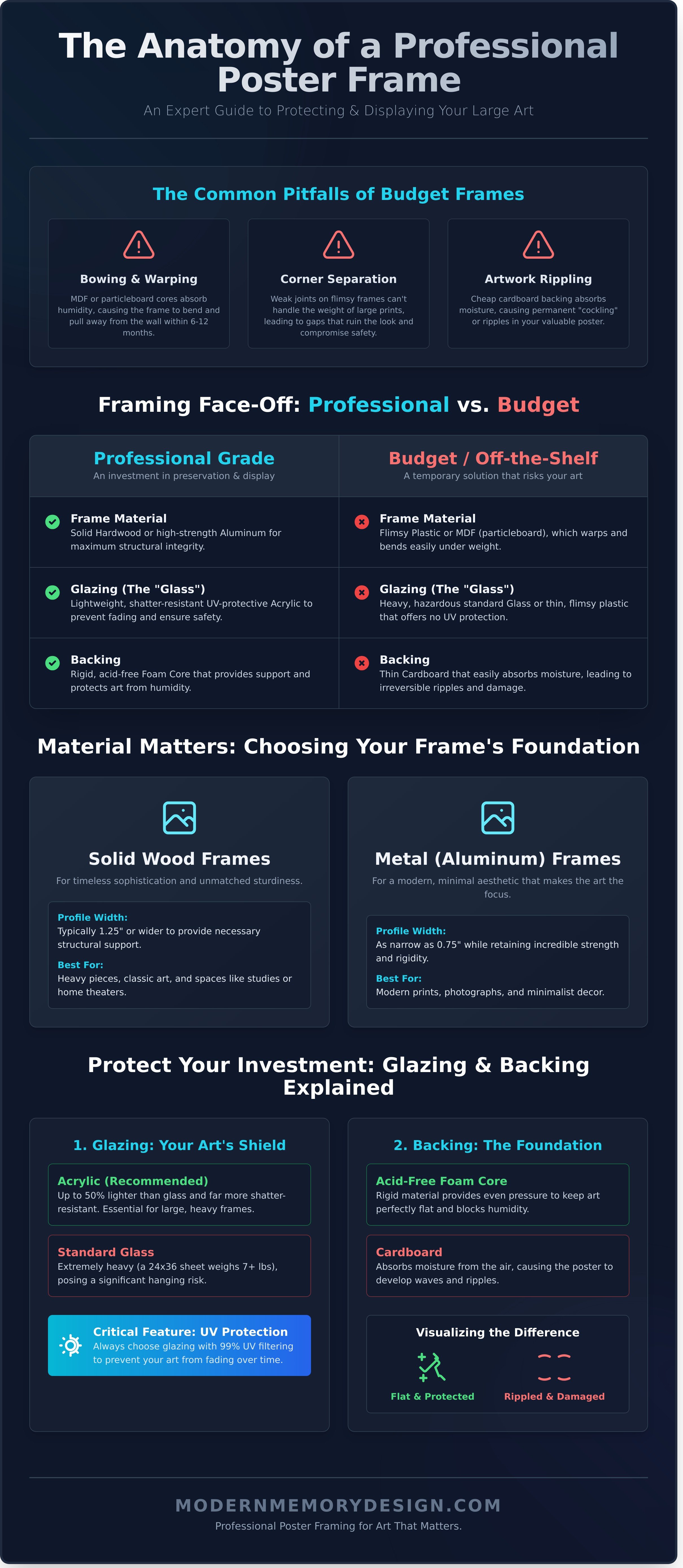
- Weight Considerations: A 24x36 inch sheet of standard glass can weigh over 7 pounds, putting immense strain on frame joints and making it hazardous to hang. For this reason, quality large-format frames use acrylic glazing, which is up to 50% lighter and significantly more shatter-resistant.
- Profile Width: A thin, 0.75-inch frame profile offers a clean, modern aesthetic. To prevent bowing under the load of a large print, this profile must be made from a rigid material like aluminum. A solid wood frame often requires a wider profile, typically 1.25 inches or more, to provide the necessary structural support without flexing.
- Backing Materials: Cheap frames often use a thin sheet of cardboard for backing. This material can absorb moisture, leading to ripples or "cockling" in the poster paper. Professional framers use rigid, acid-free foam core backing, which provides consistent pressure to keep the print flat and protects it from humidity and environmental damage.
When to Invest in Professional Quality
Deciding when to upgrade from a big-box store frame to a professional, custom-built solution depends on the value and significance of your print. If you have a limited edition concert poster, a vintage movie print, or a fine art photograph, professional framing isn't a luxury; it's a necessity for preservation. These pieces require archival care to prevent fading and degradation.
Many have experienced the "Warp Factor." A budget frame that looks great on day one often begins to fail within six to twelve months. Its particleboard (MDF) core absorbs humidity, causing the rails to bow outward and the corners to separate. This not only ruins the display but can permanently damage the artwork inside. Don't let a $30 frame destroy a $150 print. Archival framing is the professional standard for any print you value at over $50, ensuring its protection and longevity.
Selecting the Best Materials: Wood, Metal, and Modern Composites
The material of your frame does more than just hold the glass; it defines the artwork's character, ensures its longevity, and supports its weight. Your choice between the warmth of wood, the clean lines of metal, or the innovation of composites directly impacts both the aesthetic and the structural integrity of your display. This is especially critical for oversized art, where the frame's material is the first line of defense against warping and damage.
Solid Wood Poster Frames
Nothing matches the classic, organic appeal of solid wood. For spaces like home theaters, studies, and executive offices, the rich grains of oak, maple, and walnut add a layer of timeless sophistication. These materials don't just look substantial; they are. The dense grain of solid hardwood provides superior screw-holding power, offering the best "grip" for hanging hardware on heavy, large-format pieces. This ensures your investment remains securely on the wall for decades.
Style Tip: A professionally framed piece should complement your space, not compete with it. You can create a cohesive and polished look by using custom picture frame molding to match the finish of your existing furniture, such as a walnut desk or a maple bookshelf.
Metal and Aluminum Frames
When you want the art to take center stage, a metal frame is the expert choice. Aluminum allows for an incredibly strong yet minimal "thin-line" profile, some as narrow as 1/4 inch, without sacrificing structural integrity. This sleek, industrial aesthetic is the go-to for modern gallery walls and minimalist interiors. The true advantage of metal, however, lies in its exceptional weight-to-strength ratio. An aluminum frame can offer up to 30% more rigidity than a wood profile of the same weight, making it the undisputed king for very large poster displays, especially those over 48 inches wide.
Furthermore, metal's inherent resistance to corrosion makes it perfect for high-humidity environments like bathrooms or finished basements. Protecting your art is paramount, and understanding the environmental factors in art preservation is key. Metal's stability against moisture-induced warping gives it a clear advantage for long-term protection in less-than-ideal conditions.
The Rise of Sustainable Composites
Looking ahead, sustainability is shaping the future of interior design. As decor trends for 2026 lean into eco-conscious materials, modern wood composites are gaining significant traction. These innovative materials are often crafted from recycled wood fibers and eco-friendly resins, offering the look of wood with enhanced durability and a smaller environmental footprint. They provide excellent resistance to chipping and fading, making them a practical and responsible choice for high-traffic areas. As you select your next poster frames, consider how these forward-thinking materials can align your home's style with sustainable values. To see which material best suits your print, you can explore our handcrafted frame collections today.
Standard Poster Sizes vs. Custom Framing: Finding the Perfect Fit
You've found the perfect print, but now comes the real challenge: finding a frame that fits. The world of poster frames is often split into two paths: readily available standard sizes and precision-cut custom options. Off-the-shelf frames typically come in a few common dimensions, with 18x24, 24x36, and 27x40 inches being the most prevalent. These sizes are designed to accommodate the majority of mass-market prints. But what happens when your art doesn't fit the mold? Understanding the difference is the first step to a professional display.
The 24x36 Poster Frame: The Industry Standard
For decades, the 24x36 poster frame has been the undisputed champion for music, art, and decorative prints. Its 2:3 aspect ratio is an efficient standard for commercial printers, making it the most common size you'll find. If your print is slightly smaller, like 22x34 inches, you can carefully center it on an acid-free backboard. However, buying a generic 24x36 frame from a big-box retailer often means you get what you pay for: flimsy acrylic that scratches easily, warped backing boards, and joints that don't quite meet. A quality frame ensures your art is the focus, not the flaws around it.
Movie poster collectors know that one size rules them all: 27x40 inches. This is the official dimension for a "One-Sheet," the standard promotional poster sent to theaters since the early 1980s. Trying to squeeze an authentic One-Sheet into a 24x36 frame is a recipe for disaster. For these valuable pieces, the correct size isn't just a preference; it's a requirement for proper presentation and preservation.
Adding a mat board completely changes the sizing equation. A mat provides visual breathing room and, more importantly, prevents your poster from touching the glazing (glass or acrylic), which can cause damage over time. The math is simple: a 2-inch mat around a 24x36 inch poster requires a 28x40 inch frame. Using archival, acid-free materials is non-negotiable for protecting your art, a principle supported by the professional guidelines on matting and framing developed by conservation experts. This is where standard sizes often fall short, pushing you toward a custom solution.
Custom Sizing for Unique Dimensions
When "standard" isn’t an option, precision is key. This is especially true for vintage prints, international paper sizes (like A1 or A2), or limited-edition art with unique dimensions. Always follow the golden rule: measure twice, order once. Use a steel tape measure to get the exact height and width of your poster, edge to edge. Don't rely on the dimensions printed on the packaging, as they can be off by as much as a quarter-inch.
The clear advantage of ordering custom frames online is eliminating compromise. You get a frame built to the exact millimeter for your piece. This means no awkward gaps or crushed edges from trying to "make it fit." It also allows you to account for the frame's "rabbet," the inner lip that holds your art package. A standard rabbet is about 1/4 inch deep, but if you're framing a thick giclée print on 300 gsm paper with a mat, you'll need a deeper rabbet to hold everything securely without bowing the backboard. A custom solution ensures a perfect, lasting fit every time.
Protection and Longevity: Glazing, Backing, and Mounting
A beautiful frame provides the structure, but the real work of preserving your favorite poster happens between the molding. The materials you choose for glazing (the clear front), backing (the rear support), and mounting are critical for protecting your print from damage, fading, and environmental factors. Think of these components as the silent guardians of your art.
The first major decision is the glazing. While traditional glass is an option, it presents significant challenges for larger prints. For any piece over 24 inches, the debate between glass and acrylic (often known by the brand name Plexiglass) has a clear winner for both safety and practicality. A 24x36 inch sheet of standard glass weighs around 11 pounds and can shatter into dangerous shards if dropped. An equivalent sheet of framing-grade acrylic weighs just 5 pounds, is shatter-resistant, and offers superior optical quality.
Why Acrylic is the Standard for Poster Frames
Modern acrylic isn't the easily-scratched plastic of the past. Professional framers prefer it for large-scale projects because it's safer in high-traffic areas, and its reduced weight means you can hang large poster frames securely without needing heavy-duty wall anchors. Today's museum-grade acrylic also provides up to 99% UV protection and features anti-glare finishes that ensure crystal-clear viewing from any angle, rivaling the most expensive museum glass.
Protecting your poster from sunlight is essential. Standard glass only blocks about 65% of damaging UV rays, leaving your print vulnerable to fading within a few years. Conservation-grade glazing, available in both glass and acrylic, blocks over 98% of UV radiation. This is the professional standard for ensuring the vibrant reds, deep blues, and rich blacks of your poster look just as brilliant in a decade as they do today.
Behind the print, the right backing and mounting technique provide the foundation for a professional, flat display. The two primary methods are:
- Dry Mounting: A permanent process where a heat-activated, acid-free adhesive tissue is used to bond the poster to a rigid backing board. This is the ideal solution for most posters, as it guarantees a perfectly smooth, ripple-free appearance that will never sag.
- Hinging: A reversible, archival technique where the top of the artwork is attached to the backing board with small, acid-free paper "hinges." While this is the standard for original art or limited-edition prints, it may not prevent slight waviness in large, thin poster paper over time.
Finally, the backing board itself is your last line of defense against environmental damage. Standard cardboard or foam core contains acidic compounds like lignin, which leach into the paper and cause that familiar yellow, brittle look. This damage can become noticeable in as few as 5 years. Choosing a certified acid-free and lignin-free backing board is a small investment that pays off with decades of preservation.
Preventing the "Poster Ripple"
Paper naturally expands and contracts with changes in humidity, causing waviness or "ripples," especially in large prints. Proper mounting helps, but spacers are another key tool. These small, hidden strips fit inside the frame's rabbet to create a tiny air gap between the poster and the glazing. This prevents moisture from getting trapped against the print's surface. For any artwork you intend to keep for more than a few years, using exclusively acid-free materials for backing and mounting is non-negotiable for long-term preservation.
Don't let your art degrade over time. Ensure your favorite pieces last a lifetime. Explore our custom poster frames with built-in archival protection and expert craftsmanship.
Professional Poster Framing with Modern Memory Design
Choosing the right frame is the final, crucial step in turning a beloved print into a piece of art for your home. While the options can seem endless, at Modern Memory Design, we simplify the process by combining the convenience of online shopping with the unmatched expertise of a traditional frame shop. Every single frame we build is handmade with meticulous care by our team of expert craftspeople right here in our Hasbrouck Heights, New Jersey workshop. This commitment to American craftsmanship means we control every aspect of quality, from sourcing premium materials to the final assembly.
We understand the hesitation that comes with ordering large or delicate items online. That’s why we’ve perfected our shipping process to ensure your order arrives in flawless condition. We use custom-built, heavy-duty boxes, reinforced with 1.5-inch foam corners for maximum impact protection. For large poster frames, we use high-quality, shatter-resistant acrylic glazing, which is 50% lighter than glass and offers superior clarity. Our dedication to quality craftsmanship extends beyond prints, too. We apply the same principles to create stunning displays for unique items, from custom jersey frames that celebrate your favorite team to elegant shadow boxes designed to preserve 3D memorabilia.
Custom Framing Made Simple
Our intuitive online design tool puts you in control. Simply upload a digital file or enter your poster’s dimensions to begin. You can visualize your piece with hundreds of frame and mat combinations, ensuring the final look is exactly what you envision. Unlike big-box stores, we don't compromise on quality for speed. Most custom orders are handcrafted and ready to ship in just 4-6 business days. We believe in making "Museum Quality" the standard, using archival materials like acid-free mat boards to prevent discoloration and UV-protective acrylic that blocks up to 99% of harmful rays, preserving your art for decades.
Local Service for the Tri-State Area
For those in our community, we offer a personal touch that online-only retailers can’t match. We invite you to visit our Bergen County workshop for a one-on-one consultation to explore materials and design options in person. To complete the experience, we also provide a professional picture hanging service for residents across New York City, New Jersey, and Connecticut. Our team will ensure your newly framed art is hung securely and perfectly placed, giving you a truly full-service framing solution.
Ready to give your art the presentation it deserves? Browse our collection of poster frames and start your project today!
Bring Your Walls to Life with Expert Framing
Choosing the right frame transforms your art from a simple print into a lasting display. You now have the knowledge to select the perfect material, from timeless wood to modern metal, and the right protection, like UV-filtering glazing, to prevent fading for years to come. Whether you need standard sizes or a custom fit, understanding these details is the first step toward a stunning presentation.
When you’re ready to invest in that perfect finish, the expert team at Modern Memory Design is here to help. Each of our poster frames is meticulously built by hand in our New Jersey workshop, a commitment to quality that has earned us a 4.9/5 star customer rating. Don't let your art wait. Shop handmade poster frames at Modern Memory Design, enjoy free shipping on standard orders, and give your space the beautiful reflection of you it deserves.
Frequently Asked Questions About Poster Frames
What is the most common size for a poster frame?
The most common standard poster size is 24x36 inches, which is often used for movie posters and art prints. Other popular sizes you’ll frequently see are 18x24 inches and 27x40 inches. While these ready-made sizes are widely available, we find that over 60% of our clients require custom dimensions to perfectly fit their unique prints. Our expert framers can handcraft a frame to any size you need.
Can I frame a poster without a mat?
Yes, you can absolutely frame a poster without a mat for a clean, modern look called a "full-bleed" presentation. This style allows the artwork to extend to the very edge of the frame. However, adding a mat creates a classic, professional border and provides a critical air gap. This gap prevents the poster from direct contact with the glazing, protecting it from potential moisture damage over time.
Is acrylic or glass better for large 24x36 poster frames?
For large 24x36 poster frames, acrylic is the superior and safer choice. It is up to 50% lighter than glass, which makes hanging large pieces much more secure. Acrylic is also shatter-resistant, a crucial feature for shipping and for homes with children or pets. We exclusively use framing-grade acrylic that offers 99% UV protection, which is essential to prevent your poster's colors from fading due to light exposure.
How do I stop my poster from rippling inside the frame?
To permanently stop a poster from rippling, it must be professionally mounted to a rigid, acid-free backing board. Rippling, or "cockling," is caused by changes in humidity that make the paper expand and contract. Our expert dry-mounting service uses a heat-activated, pH-neutral adhesive to bond the poster to the backer, ensuring it remains perfectly flat and smooth for years to come, regardless of environmental changes.
What is the difference between a poster frame and a picture frame?
The main difference between a generic poster frame and a custom picture frame is the quality of the materials used. Many mass-produced frames use plastic or MDF moldings with thin, flimsy backing. At Modern Memory Design, we use the same high-quality, solid wood and archival materials for all our frames, whether for a family photo or a large poster. This ensures your poster is protected and displayed with museum-quality craftsmanship.
How much does it cost to frame a large poster professionally?
Professionally framing a large 24x36 poster typically costs between $150 and $450. The final price depends on your specific choices. A simple, 1.25-inch wide solid wood frame with our standard UV-protective acrylic will be on the lower end of that range. Opting for a wider, more ornate frame, adding double mats, or upgrading to museum-grade anti-reflective acrylic will increase the investment but provide superior presentation and protection.
Do you offer custom sizes for international posters?
Yes, we specialize in creating custom frames for any size, including all international standards like A0, A1, and B2. Since every frame is handmade to order in our Bergen County, NJ workshop, we don't have size limitations. Simply measure your international poster in inches or centimeters and enter the exact dimensions into our online frame builder. We will craft a perfectly fitted frame just for you.
Are your frames made of real wood or plastic?
All of our frames are handcrafted from 100% solid wood, sourced from sustainable suppliers. We believe real wood offers superior durability, strength, and a timeless aesthetic that plastic or composite materials cannot replicate. Each piece of wood molding is precisely cut, joined, and finished by our expert framers in our New Jersey facility, guaranteeing a level of quality and craftsmanship that is Made in the USA.
Leave a comment